
The force formula (F=ma), explained
The force formula is F = ma: force equals mass times acceleration. Here's what it means, how to calculate force, and how a force plate actually measures it.
Published July 29, 2026
The force formula is F = ma: the force acting on an object equals its mass multiplied by its acceleration. It’s one of the most fundamental equations in physics, and it’s the principle a force plate uses to turn an athlete’s movement into a force measurement.
What is the force formula?
The force formula is F = m × a: force equals mass times acceleration. It’s Newton’s second law of motion: the force acting on an object equals its mass multiplied by the acceleration that force produces. Rearranged (a = F/m), it also says a given force accelerates a light object more than a heavy one.
- F: force, in newtons (N)
- m: mass, in kilograms (kg)
- a: acceleration, in metres per second squared (m/s²)
The newton: the unit of force
Force is measured in newtons (N), after Isaac Newton. One newton is the force needed to accelerate one kilogram at one metre per second squared:
1 N = 1 kg · m/s²So the units aren’t arbitrary; they come straight out of F = ma.
How to calculate force
To find a force, multiply mass by acceleration. Two quick examples:
- A 5 kg medicine ball accelerated at 2 m/s² needs a force of 5 × 2 = 10 N.
- A 0.15 kg ball driven so it accelerates at 300 m/s² experiences 0.15 × 300 = 45 N.
The same formula scales from a thrown ball to a sprinter driving out of the blocks.
Mass vs weight: the force of gravity
A common mix-up: mass and weight are not the same thing. Mass (in kg) is how much matter an object contains. Weight is a force, the pull of gravity on that mass, so it’s measured in newtons:
Weight (N) = mass (kg) × g, where g ≈ 9.81 m/s²An 80 kg athlete has a mass of 80 kg but a weight of about 80 × 9.81 ≈ 785 N. That’s what a force plate reads when they stand still on it: their bodyweight, expressed as a force.
How a force plate measures force
A force plate measures force using Newton’s third law: every force you push into the ground is met with an equal and opposite ground reaction force. Push into the plate and it records that reaction force, hundreds of times a second, producing a force-time curve for the whole movement. (Our force plate basics guide goes deeper on how that works, and force plate testing covers the tests built on it.)
That’s the difference between a physics-class formula and a measured number: a force plate doesn’t calculate force from an assumed acceleration. It reads the actual force directly.
Worked example: the force of a jump
Put F = ma and the force plate together with a jump by an 80 kg athlete:
- Standing still, the plate reads their weight: ≈ 785 N.
- To jump, they push down harder than that. By Newton’s third law the plate pushes back up, and the net upward force (the reading above bodyweight) is what accelerates them: Fnet = m × a.
- If the plate peaks at 1,570 N during the push, the net upward force is 1,570 − 785 = 785 N, accelerating the athlete upward at a = 785 ÷ 80 ≈ 9.8 m/s².
- On landing, the athlete decelerates in a fraction of a second, so the peak force can reach three to five times bodyweight, which is why landing mechanics matter so much for injury risk.
Peak force, the highest point on that curve, is one of the most-used numbers in force plate testing, usually read relative to bodyweight.
From force to performance
Force applied over time is impulse (force × time), and impulse is what changes an athlete’s momentum. That’s how a force plate turns the force-time curve into performance metrics: by summing the impulse it works out take-off velocity, and from there jump height. This is the impulse–momentum method behind the countermovement jump. See what we measure for the full set of metrics that come out of the force signal.
In short
F = ma is the whole idea in three letters: force is mass times acceleration, measured in newtons. What turns it from a classroom equation into a coaching tool is measuring the force directly, which is what a dual force plate like the PlateMate does, hundreds of times a second, for every jump, landing and push.
Want to see force measurement in action? Get in touch with the CC Athletics team.
Frequently asked questions
What is the force formula?
The force formula is F = m × a: force equals mass times acceleration. It is Newton's second law of motion. Force is measured in newtons (N), mass in kilograms (kg), and acceleration in metres per second squared (m/s²).
What is the unit of force?
Force is measured in newtons (N). One newton is the force needed to accelerate a mass of one kilogram at one metre per second squared, so 1 N = 1 kg·m/s². The unit falls straight out of F = ma.
How do you calculate force?
Multiply mass by acceleration: F = m × a. For example, a 5 kg object accelerated at 2 m/s² experiences a force of 10 N. To find weight (the force of gravity on a mass) use F = m × g, where g ≈ 9.81 m/s².
What is the difference between mass and weight?
Mass (in kilograms) is how much matter an object contains; weight is the force gravity exerts on that mass, so it is measured in newtons (weight = mass × g). An 80 kg athlete has a mass of 80 kg but a weight of about 785 N, which is what a force plate reads when they stand still on it.
How do force plates measure force?
By Newton's third law: every force you push into the ground is met with an equal and opposite ground reaction force. A force plate records that reaction force hundreds of times a second, producing a force-time curve. It measures the force directly rather than calculating it from an assumed acceleration.
What is peak force?
Peak force is the highest force recorded during a movement (the top of the force-time curve), such as the maximum force during a jump push-off or a landing. It is one of the most-used numbers in force plate testing, and is often expressed relative to bodyweight.
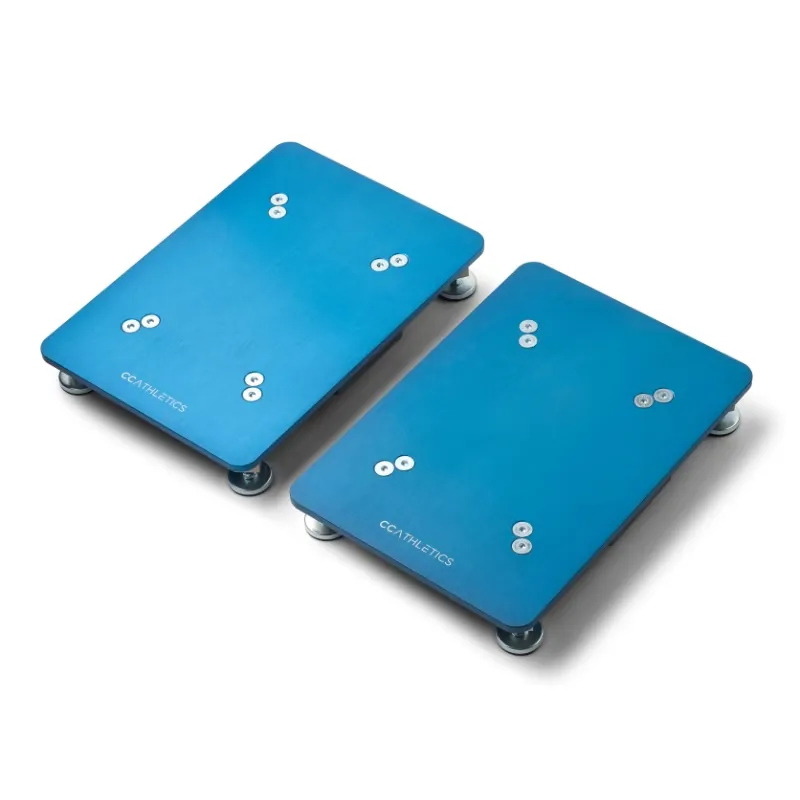
The product behind this article
PlateMate
Dual force plates with 4 000 kg max load and externally validated precision.
Explore PlateMate →