
Countermovement Jump (CMJ): what it measures and how to test it
The countermovement jump is the most widely used force plate test. Here's what it measures, how the plates capture it, and what a good score looks like.
Published July 27, 2026 · Updated August 27, 2026 · 9 min read
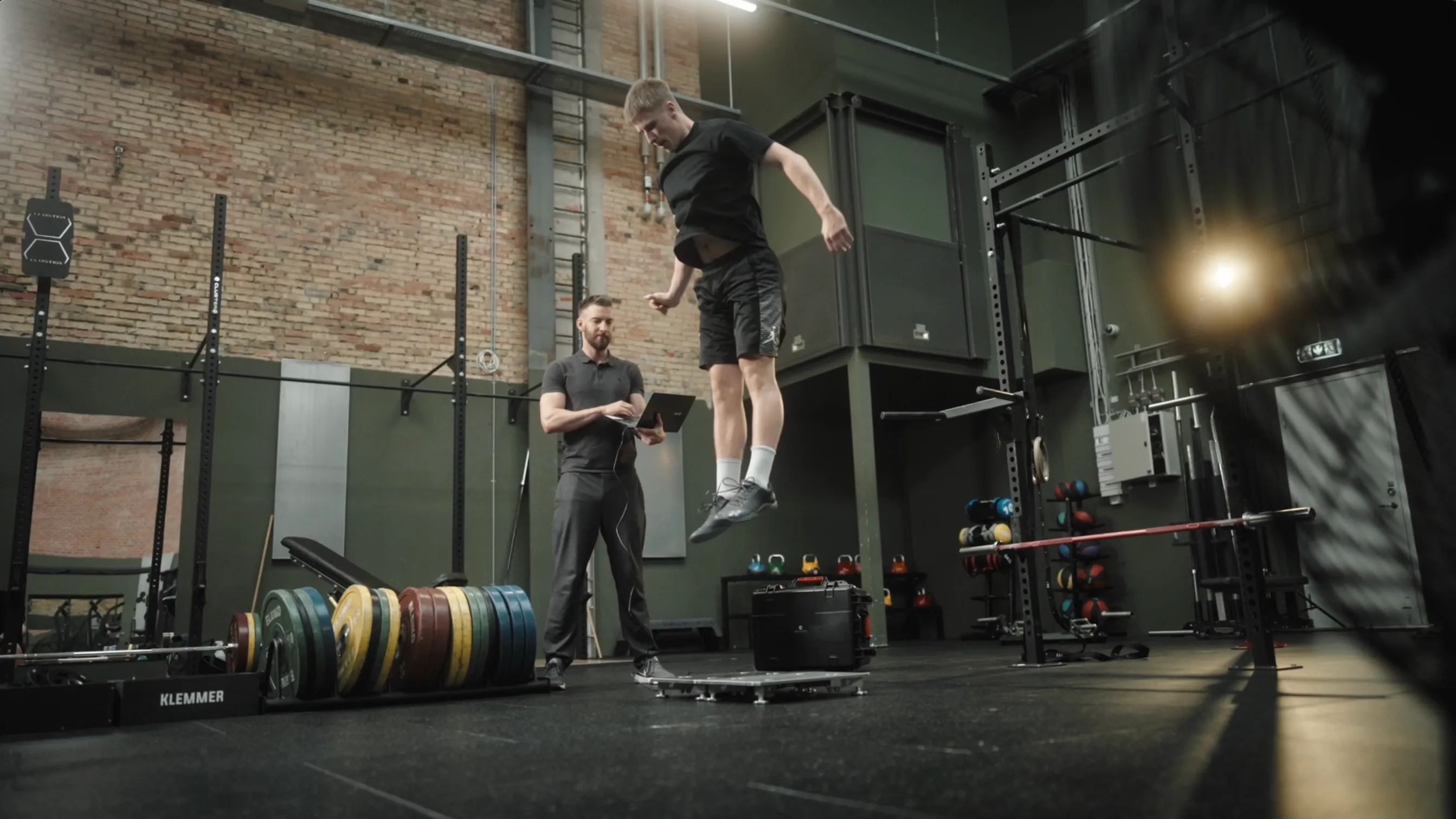
A countermovement jump (CMJ) is a vertical jump that starts from standing: the athlete dips down quickly, then immediately reverses and jumps as high as they can, usually with hands on the hips. It is the single most widely used test in force plate assessment — quick to perform, low in fatigue, and rich in information about lower-body power and neuromuscular readiness.
This guide explains what the CMJ is, what it actually measures, how a force plate captures it, and what a good score looks like.
Already comfortable with the basics? For the deeper dive — reading the force-time curve itself, separating output from movement strategy, and telling a real change from normal variability — see our CMJ force-time analysis guide.
What is a countermovement jump?
The “countermovement” is the downward dip that precedes the jump. Rather than starting from a held squat, the athlete dips down — usually to around a half-squat, though the exact depth is self-selected — and springs straight back up in one continuous movement.
That dip matters. Lowering quickly and reversing without pausing loads the muscles and tendons like a stretched spring — a mechanism called the stretch-shortening cycle (SSC). The energy stored on the way down is reused on the way up, so a countermovement jump is almost always higher than a jump from a static squat. Comparing the two is itself a useful test: the difference tells you how well an athlete uses elastic energy.
Because it needs no equipment beyond the plates and takes seconds to perform, the CMJ has become the default measure of lower-body explosive capability in sport and rehabilitation.
What does a CMJ measure?
At face value, the CMJ measures how high someone can jump. But the value of testing it on a force plate is everything underneath the jump height:
- Explosive lower-body power — how much force the athlete can produce, and how quickly.
- Neuromuscular readiness and fatigue — day-to-day changes in how the jump is produced flag whether an athlete is fresh or fatigued, often before they feel it.
- Movement strategy — two athletes can reach the same height using very different combinations of depth, speed, and force. The force-time curve shows which.
- Left–right asymmetry — on a dual plate, each limb’s contribution is measured separately, exposing imbalances that matter for performance and injury risk.
That last point is why the CMJ is central to return-to-play decisions: jump height can look fully recovered while one limb is still quietly doing less work. Those same outputs widen its use well beyond readiness: a whole squad can be tested in minutes, making the CMJ a quick first screen for explosive capability in talent identification, and the force-time curve can point training or rehab at the phase — braking or propulsion — that needs the work.
How does a force plate capture the CMJ?
A force plate records ground reaction force hundreds of times per second, producing a force-time curve for the whole movement. The jump breaks into clear phases you can read directly off that curve:
- Quiet standing — the plate reads the athlete’s bodyweight. This baseline is what everything else is measured against.
- Unweighting — as the athlete drops, force falls below bodyweight.
- Braking (eccentric) — the downward motion is decelerated; force climbs back up and peaks as the athlete reaches the bottom and momentarily stops. That brief reversal at the bottom, from braking into upward drive, is the transition (or amortization) phase.
- Propulsion (concentric) — the athlete drives upward. Force stays above bodyweight while the body accelerates, then falls away — dropping below bodyweight as the athlete slows for take-off, and reaching zero the moment the feet leave the plate.
- Flight — force reads zero while the athlete is airborne.
- Landing — force spikes sharply on contact.
Jump height is then calculated from the physics rather than guessed. Software like ForceMate integrates the net force to find the athlete’s velocity at take-off, and derives jump height from that take-off velocity. This impulse–momentum method is more accurate than estimating height from flight time alone, because it doesn’t depend on the athlete landing in exactly the same posture they took off in.
Key CMJ metrics
A single CMJ produces dozens of metrics. You don’t need all of them — a handful cover most decisions:
| Metric | What it tells you |
|---|---|
| Jump height | The overall output of the jump |
| Peak / mean power | Explosiveness — how much power the athlete generates |
| Rate of force development (RFD) | How quickly force is produced, not just how much |
| Time to take-off (contraction time) | How long the whole movement takes, from the first dip to leaving the ground |
| Countermovement depth | The movement strategy — how far they dip |
| Eccentric vs. concentric metrics | Whether force is produced on the way down, the way up, or both |
| RSI-modified (height ÷ time to take-off) | Explosiveness relative to how long the jump takes |
| Asymmetry (left vs. right) | Imbalance between limbs — a performance and injury flag |
A practical starting set is jump height, peak power, and asymmetry — add RFD and RSI-modified once you’re comfortable reading the curve.
For a deeper dive into the curve itself — standardising the test, separating output from movement strategy, and deciding whether a change between sessions is real — see our CMJ force-time analysis guide.
What’s a good CMJ score?
This is the most-asked question and the one with the most caveats. Jump height depends heavily on age, sex, sport, training history, and testing protocol (hands on hips versus an arm swing can add several centimetres on its own). Treat the ranges below as rough orientation, not targets:
| Population | Approximate CMJ height (hands on hips) |
|---|---|
| Recreationally active adult (male) | ~25–35 cm |
| Trained male athlete | ~35–45 cm |
| Elite male in an explosive sport | ~45–60+ cm |
| Female athletes | typically ~5–10 cm below the equivalent male band |
The more important point: the most useful comparison is an athlete against their own baseline, not against a population norm. A 3 cm drop from an athlete’s normal jump height, or a widening left–right asymmetry, is far more actionable than where they sit on a general table. This is exactly what regular force plate testing gives you — a trend you can trust.
How to run a reliable CMJ test
The CMJ is only as repeatable as your protocol. A few habits keep the numbers meaningful:
- Standardise the arms. Hands on hips removes arm swing as a variable. If you test with an arm swing — the free-arm variant is often called the Abalakov (or CMJA) jump — keep it consistent every time; don’t mix the two within a comparison.
- Keep cues identical. Same instruction, same wording, every session. “Dip and jump as high and as fast as you can” produces a different jump from “jump as high as you can.”
- Let the athlete self-select depth. Forcing a fixed depth changes the strategy you’re trying to measure. Let them find their natural countermovement.
- Stand still before each rep. The software needs a quiet standing period to read true bodyweight and detect the correct start of the movement. Impulse driven metrics will also drift if there isn’t a clear distinction of when the jump starts.
What throws the numbers off. A handful of common execution faults distort a CMJ enough to mislead:
- Hands leaving the hips mid-jump quietly reintroduces arm swing, adding several centimetres to jump height — the very variable the cue above is meant to remove.
- A loss of balance or a sideways lean shifts load between the two plates and corrupts the left–right asymmetry read, since each plate measures one limb.
- A slow, drawn-out countermovement lets the stored elastic energy dissipate before the drive; you then measure a weaker stretch-shortening cycle rather than the athlete’s reactive quality.
- A soft, collapsing, or asymmetric landing is worth cueing — but note why. Devices that infer height from flight time overestimate it when the athlete tucks or bends the knees on landing; ForceMate derives height from take-off velocity (the impulse–momentum method above), so jump height is immune to this. Landing force and landing asymmetry, though, are read from the landing itself, so a poor landing still distorts those.
For the exact step-by-step protocol and a demo video, see the CMJ instructions in our Test Library.
Why measure the CMJ with a force plate?
A jump mat or a phone app can estimate jump height, but they only see the outcome — how high, and nothing about how it was produced. A force plate measures the force itself, so you can see the eccentric and concentric phases separately, quantify each limb’s contribution, and track how a jump changes even when the height hasn’t moved.
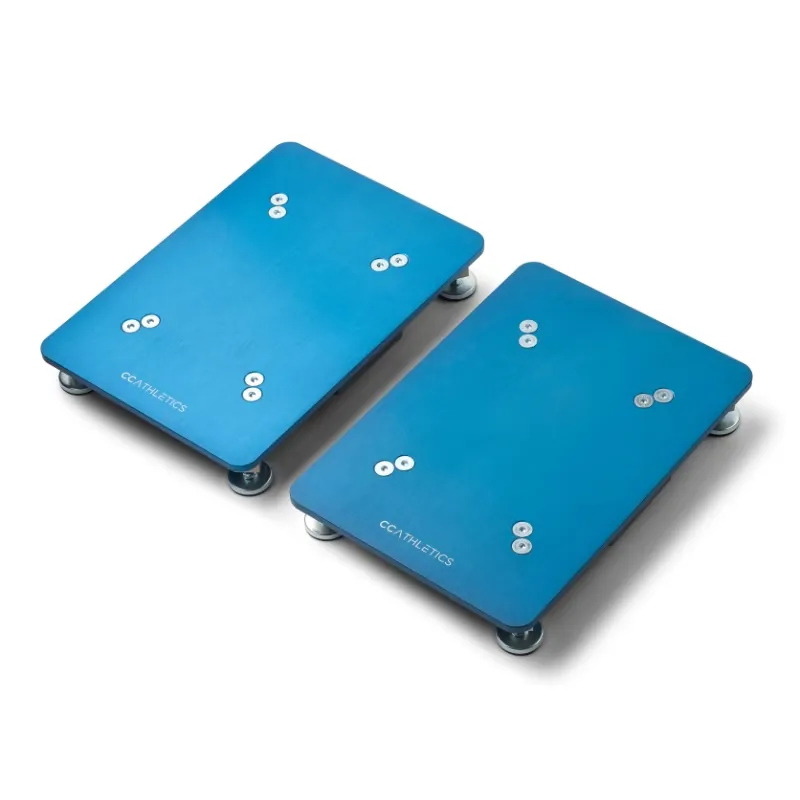
The PlateMate is a portable dual force plate built for exactly this: run a CMJ in seconds, get jump height, power, asymmetry, and the full force-time curve in ForceMate, and track every athlete’s trend over time. Each plate measures one limb, so left–right asymmetry comes for free on every jump — no separate test needed.
Getting started
If you’re adding the CMJ to your testing for the first time, keep it simple. Establish a baseline for each athlete with hands on hips, track jump height, peak power, and asymmetry, and re-test on a consistent schedule across a training block. Show athletes their own curve — the visual feedback alone tends to sharpen how hard they drive into each jump.
From there, the CMJ becomes a quick, low-fatigue window into readiness, power, and balance that you can run as often as you like — the reason it’s the cornerstone test on every force plate in the field.
Want to see how the PlateMate handles jump testing in your setting? Get in touch with the CC Athletics team.
Frequently asked questions
What is a countermovement jump?
A countermovement jump (CMJ, sometimes written 'counter movement jump') is a vertical jump that begins from standing: the athlete dips down quickly and, without pausing, reverses into a maximal jump — usually with hands on the hips. It is the most widely used force plate test of lower-body explosive power and neuromuscular readiness.
Is the countermovement jump an exercise or a test?
It is primarily a test rather than a training exercise. The CMJ is used to measure lower-body power, readiness and left–right asymmetry rather than to build them — the jump can appear in training, but on a force plate its value is the data each rep produces.
What is a good countermovement jump height?
As rough orientation with hands on hips, recreationally active adults jump around 25–35 cm, trained male athletes around 35–45 cm, and elite athletes in explosive sports 45–60 cm or more; female athletes typically sit 5–10 cm below the equivalent male band. The more useful benchmark is an athlete measured against their own baseline, not a population norm.
What is the difference between a countermovement jump and a squat jump?
A countermovement jump starts from standing with a fast downward dip, so it uses the stretch-shortening cycle to store and reuse elastic energy. A squat jump starts from a held squat with no dip, isolating concentric (upward) force only. Comparing the two shows how well an athlete uses elastic energy.
What muscles does the countermovement jump use?
Mainly the lower body — the quadriceps, hamstrings, gluteals and calves — working through the hips, knees and ankles, with the trunk stabilising. On a dual force plate each limb is measured separately, so you can see whether both legs share the load evenly.
How many countermovement jumps should you perform in a test?
Three maximal reps is the most common protocol, with a short rest between each and a consistent warm-up beforehand.
What is RSI-modified (RSI-mod), and how is it different from RSI?
RSI-modified (RSI-mod) is a countermovement-jump metric calculated as jump height ÷ time to take-off, capturing explosiveness relative to how long the jump takes. It is the CMJ counterpart to the Reactive Strength Index (RSI) used for drop jumps: a countermovement jump has no rebound ground contact to measure, so time to take-off stands in for it. The two are related but not interchangeable.
The product behind this article
PlateMate
Dual force plates with 4 000 kg max load and externally validated precision.
Explore PlateMate →