
Force Plate Basics: A Beginner's Guide
Force plates have left the lab. What they measure, the metrics worth starting with, the tests you can run, and how to get data you can trust.
Published July 26, 2026 · Updated July 28, 2026 · 8 min read
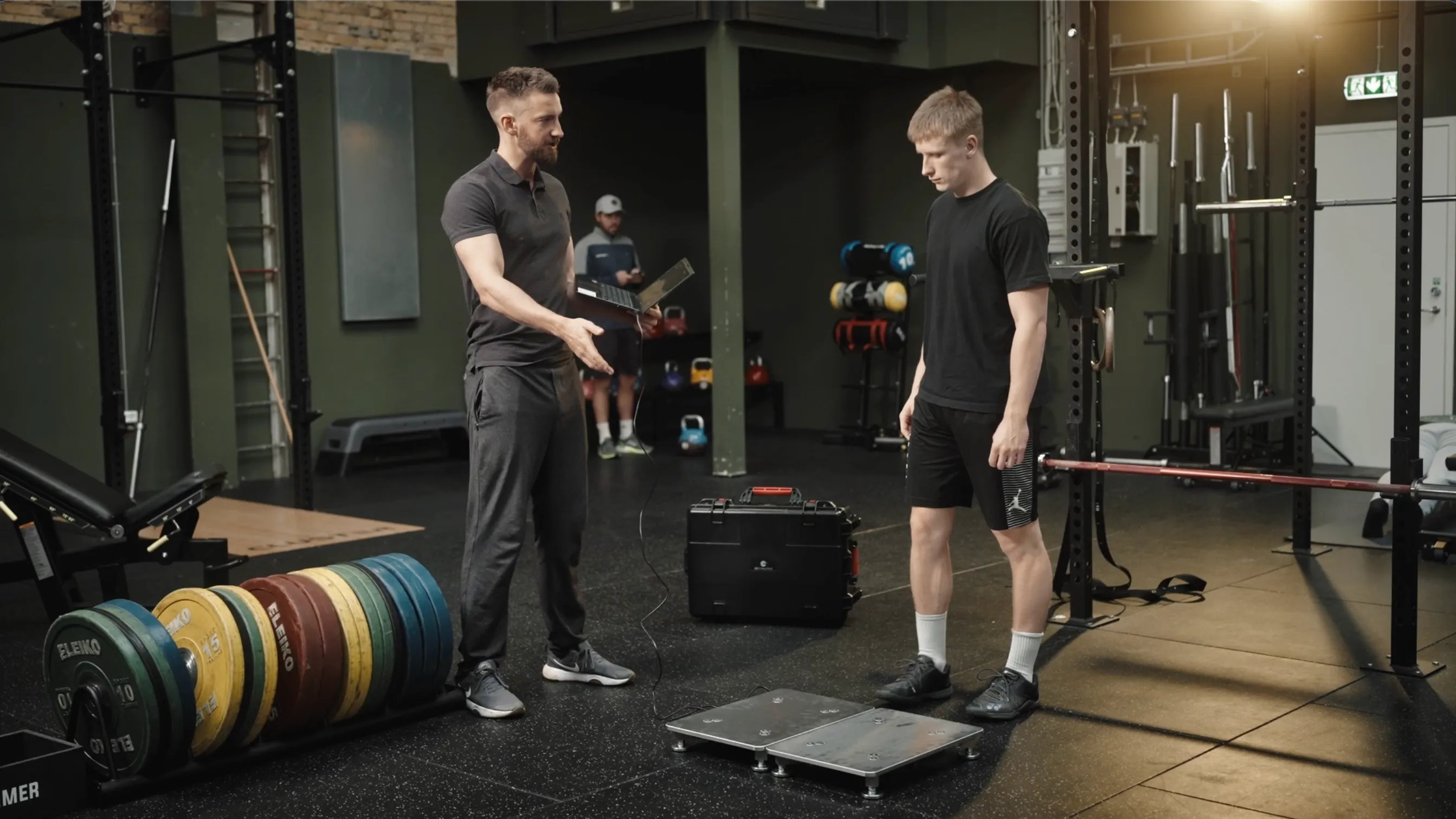
A force plate is a precision instrument that measures the force your body applies to the ground, how hard you push, jump, land or balance, and turns it into objective numbers you can track. Force plates used to live in university biomechanics labs: expensive, bulky, and reserved for researchers. That has changed. Today a portable dual force plate goes wherever you work: a physio clinic, a gym floor, or the back of a car on the way to a session.
What is a force plate?
At its core, a force plate is a very precise, very fast weighing scale. It measures the force a person applies to the ground, known as ground reaction force (GRF), and records how that force changes over time.
Each plate contains sensors, usually one in each corner, sitting beneath a rigid top surface. When someone stands, squats, or jumps on the plate, those sensors register the load and pass the readings to software many hundreds of times per second. Stand still and the plate simply reads your bodyweight. Bend, push, or leave the ground and the force rises and falls in a pattern that tells a detailed story about how you move.
The principle comes straight from Newton’s third law: every force you push into the ground is met with an equal and opposite force back. That returning force is what the plate captures.
Why measure ground reaction force?
A stopwatch or a tape measure tells you the outcome of a movement: how long someone balanced, how far they hopped. A force plate tells you how they achieved it. Two athletes can jump to the same height using completely different strategies, and only one of those strategies might be putting an injured limb at risk.
By reading the force-time curve, you can separate a movement into phases and see things you can’t judge by watching:
- Is the athlete/patient producing force evenly through both legs, or favouring one side?
- Are they stronger going down (eccentric) than coming up (concentric)?
- How quickly can they generate force, not just how much?
- Is their balance drifting in a particular direction?
This shift from time-based to criteria-based decisions is a big part of why objective measurement has become standard practice in rehabilitation and performance.
The metrics that matter
Raw force data is hard to read on its own. Good force plate software does most of the work, translating the curve into clear metrics; ForceMate calculates more than 300 of them across its test library. You’ll never need all of them at once, but a handful cover the vast majority of everyday testing. A few of the most useful, and what they represent physically:
| Metric | What it tells you |
|---|---|
| Peak force | Maximum strength or loading |
| Asymmetry | The difference between the left and right limb |
| Peak power | Explosiveness |
| Rate of force development (RFD) | How quickly force is produced |
| Reactive Strength Index (RSI) | How efficiently force is absorbed and re-produced (springiness) |
| Centre of pressure (CoP) | Balance and postural sway |
If you’re just getting started, resist the urge to track everything at once. Begin with two or three reliable metrics (peak force, asymmetry, and peak power are a sensible trio) and add more as your confidence grows. Some advanced metrics are highly sensitive but can swing test-to-test without meaningful change, which makes them frustrating for a beginner. The stable measures give you a solid foundation to trust.
Common tests you can run
Force plates aren’t limited to elite jump testing; any movement dominated by vertical force can be assessed. Here’s what you can run in ForceMate:
Jumps. The PlateMate covers a full range of jump tests, each exposing a different quality:
- Countermovement Jump: a foundational jump test for lower-body explosive power and neuromuscular readiness.
- Countermovement Rebound Jump: a countermovement jump followed by an immediate maximal rebound, pairing jump performance with reactive strength off the landing.
- Squat Jump: isolates concentric force production by removing the stretch-shortening cycle.
- Drop Jump: quantifies reactive strength and the quality of the stretch-shortening cycle.
- Pogo Jumps: repeated stiff-legged hops that measure ankle stiffness and reactive endurance.
Every jump test can be performed as either dual-leg or single-leg, so you can profile overall performance or isolate each limb to expose asymmetries.
Balance. Tracks centre of pressure (CoP) to quantify postural sway, stability, and proprioceptive control, dual-leg or single-leg.
Isometrics. Maximal force production at fixed joint angles, ideal for tracking strength and rehab progress. It’s a safe, fast alternative to repetition-maximum testing, giving you peak force, asymmetry, and speed of force production without the fatigue or injury risk of loading up a bar. You define your own tests in the software, so only your imagination sets the limit.
Movement. Live force-curve and left/right symmetry feedback for any movement on the plates, dual-leg or single-leg. Take a movement you already assess by eye and quantify the asymmetry while analysing the full force-time curve for data you were previously estimating.
Every test here has step-by-step instructions, and demo videos for the jumps, in our Test Library.
A practical starting point: pick a test you already trust and use often, then run its force plate equivalent. If you assess single-leg balance, use the balance test on one leg. If you assess squats for symmetry, run them through Movement. You keep your reasoning intact and simply gain better data.
Getting reliable data
Force plates are only as good as the conditions you test in. A few habits make a large difference:
- Use a solid, flat surface. Carpet, grass, or sprung floors distort readings. Level the plates every time.
- Zero the plates with nothing on them. Taring with weight applied creates an offset that skews everything that follows.
- Keep your cues consistent. The same instruction, in the same tone, every time. If your coaching changes, the athlete/patient’s performance changes with it.
- Follow the live feedback bar to stand still before each rep. The software needs a quiet period to detect the true start of movement.
Consistency is what turns a single measurement into a trend you can actually act on.
Where the PlateMate fits in
At CC Athletics we built the PlateMate around a simple belief: force plate testing should be quick to set up, easy to understand, and genuinely yours once you buy it.
- Fast setup. Get testing in minutes, not through a lengthy calibration ritual. The PlateMate is portable and ready wherever you work: clinic, gym, or on the road.
- Intuitive software. ForceMate turns the force-time curve into clear, actionable metrics. Easily track progression, compare legs for asymmetry, and much more. Easy to navigate and fast to understand.
- You own it. The PlateMate is a one-time purchase. No subscriptions, no recurring licence fees, no being locked out of your own data behind a paywall. See how that compares across the market in our guide to what force plates cost.
- Built with you in mind. We’re close to our users: responsive support and a product shaped by real practitioner feedback rather than a distant corporate roadmap.
Getting started
You don’t need to overhaul your setup to benefit from force plates. Start by adding one plate-based test to a movement you already coach or assess, track two or three reliable metrics, and show the numbers to your athletes. The visual feedback alone tends to sharpen intent and helps athletes understand exactly what they’re working towards.
For performance work, force plates let you profile an athlete’s strength, power, and explosiveness, then screen for left-right asymmetries before they turn into problems. Testing regularly across a training block lets you monitor readiness and fatigue, so you can train hard when an athlete is ready and reduce the load when the data says recovery is needed. Over time you build a performance profile, so training decisions rest on evidence instead of guesswork.
They’re just as valuable at the other end of the journey. When an athlete is coming back from injury, force plates give you objective limb-symmetry and force data to support return-to-play decisions, replacing a calendar date with real evidence that the injured side is ready to perform. And in a rehab setting, the same tests let you track progression and monitor both limbs through recovery.
That versatility is the point: the same plates that help a healthy athlete make small gains also confirm when a recovering one is ready to compete again. Force plates are no longer only for the research lab. They’re a practical, everyday way to test, track, and support every athlete you work with.
Want to see how the PlateMate could fit into your practice? Get in touch with the CC Athletics team.
Frequently asked questions
What is a force plate?
A force plate is a precise, fast instrument that measures the force your body applies to the ground (the ground reaction force) and how that force changes over time. Standing still it reads your bodyweight; when you bend, push or jump, the force rises and falls in a pattern that shows how you produce and absorb load.
What does a force plate measure?
Ground reaction force, and the metrics derived from it: peak force (strength and loading), left–right asymmetry, peak power (explosiveness), rate of force development (how quickly force is produced) and centre of pressure (balance and sway). It captures not just the outcome of a movement but how it was produced.
What is a force plate used for?
Testing lower-body power and explosiveness, screening left–right asymmetries, monitoring readiness and fatigue across a training block, and supporting return-to-play decisions in rehab with objective limb-symmetry data. Common tests include jumps, balance, isometric strength and general movement.
Do I need a force plate, or is a jump mat enough?
A jump mat estimates the outcome of a jump: how high, how long in the air. A force plate measures the force itself, so you can see each phase of the movement, compare the left and right limb separately, and track how a movement changes even when the height hasn't. It answers how a result was produced, not just what it was.
Are force plates only for research labs?
Not any more. Portable dual force plates like the PlateMate are used in physio clinics, gyms and out on the field; they set up in minutes and are a one-time purchase you own outright, with the software included. The lab-only era of force plates is over.
How do you get reliable force plate data?
Test on a solid, flat surface, zero the plates with nothing on them, keep your coaching cues identical every time, and have the athlete stand still before each rep so the software can detect the true start of movement. Consistency is what turns a single measurement into a trend you can act on.
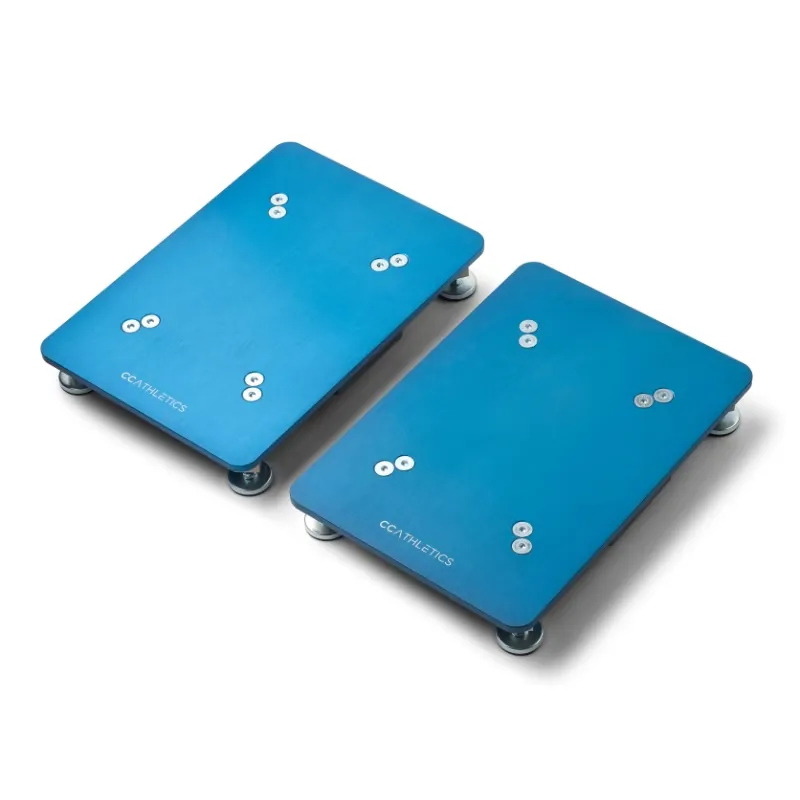
The product behind this article
PlateMate
Dual force plates with 4 000 kg max load and externally validated precision.
Explore PlateMate →