
Drop jump test and Reactive Strength Index (RSI), explained
The drop jump test measures reactive strength: how fast an athlete turns a landing into a take-off. Here's how it works, how RSI is calculated, and how to run it.
Published July 28, 2026 · 7 min read
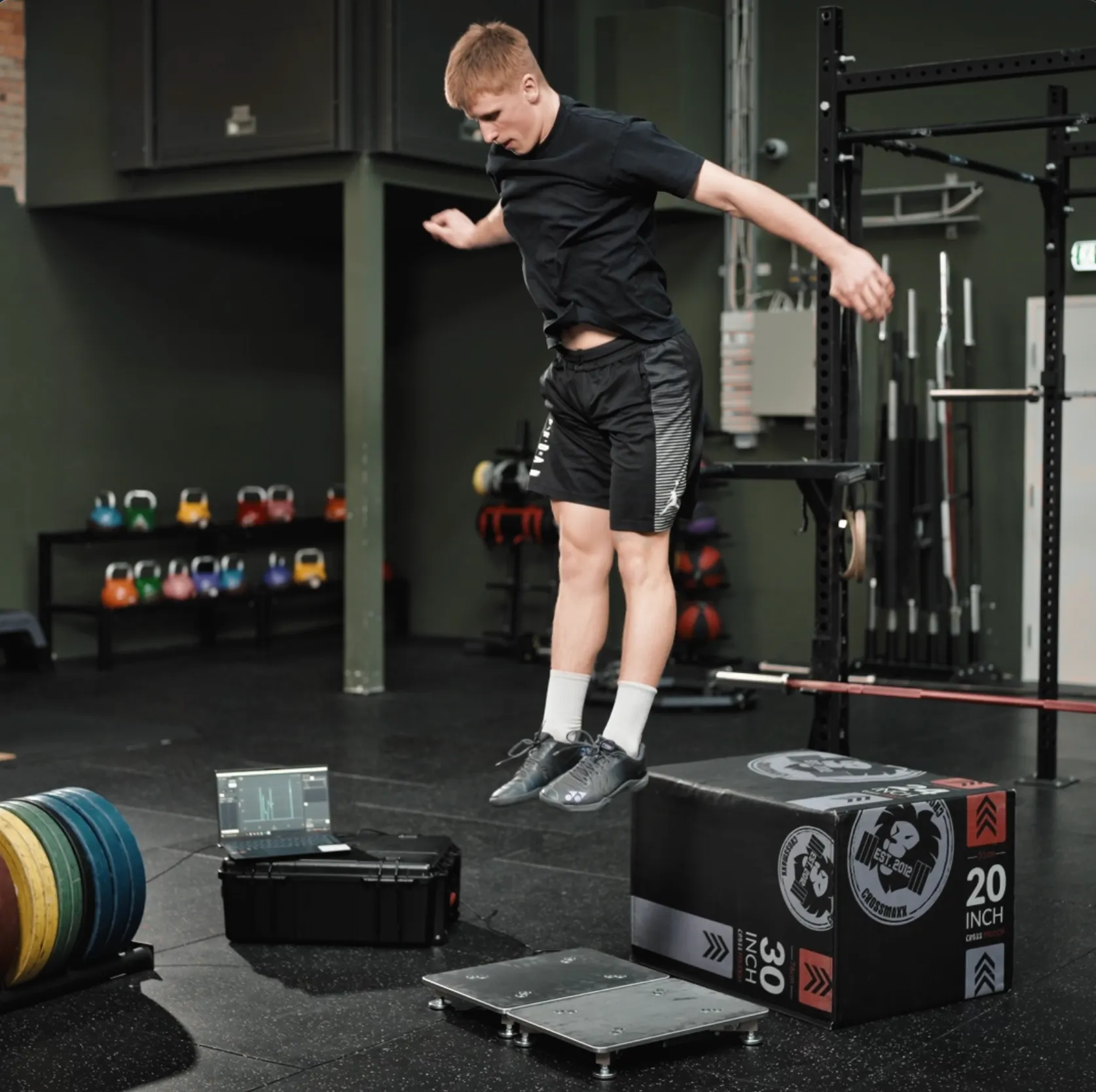
A drop jump is a plyometric test where the athlete steps off a box, lands, and immediately jumps as high as possible while spending as little time as they can on the ground. It measures reactive strength, how efficiently someone absorbs and re-uses force through a fast stretch-shortening cycle, and it’s summarised in a single number: the Reactive Strength Index (RSI).
It sits alongside the countermovement jump and is calculated from a force plate.
What is a drop jump?
In a drop jump, the athlete stands on a box (commonly 20–40 cm, sometimes higher for advanced athletes) and steps off. They drop, they don’t jump off. On landing they rebound into a maximal vertical jump. The instruction that defines the test is: spend as little time on the ground as possible while still jumping high.
That constraint is the point of the test. Landing from the box pre-loads the muscles and tendons of the lower limb, and a short, stiff ground contact releases that stored elastic energy into the jump. The shorter the amortization phase (the brief transition from landing to take-off), the less of that energy is lost. It’s a direct measure of the “fast” stretch-shortening cycle, the same quality a sprinter uses at foot-strike or a jumper uses off the floor.
How is a drop jump different from a countermovement jump?
Both jumps use the stretch-shortening cycle (SSC), but at opposite ends of it:
| Countermovement jump | Drop jump | |
|---|---|---|
| Stretch-shortening cycle | Slow (>250 ms contact) | Fast (<250 ms contact) |
| Pre-load | Self-generated dip | Landing from a box |
| Primary quality | Explosive power | Reactive strength / stiffness |
| Headline metric | Jump height, peak power | Reactive Strength Index (RSI) |
The CMJ asks how much power can you produce?; the drop jump asks how quickly can you turn a landing back into a jump? An athlete can be strong on one and unremarkable on the other, which is why testing both is informative.
A useful middle ground is the countermovement rebound jump (CMRJ), a CMJ immediately followed by a maximal rebound. It pairs jump performance with reactive strength off the landing without needing a box. ForceMate supports the drop jump, CMRJ, and repeated hops, so you can profile reactive strength however suits your athlete.
What is the Reactive Strength Index (RSI)?
The Reactive Strength Index expresses reactive strength as one number: how much height (or air time) an athlete produces relative to how long they spent on the ground producing it. A high RSI means an efficient athlete who rebounds fast; a low RSI means force is leaking away during a long, soft ground contact.
How is RSI calculated?
RSI comes from two things a force plate measures precisely on every rep: the time the feet are on the plate (ground contact time) and the time the athlete is airborne (flight time).
RSI = flight time ÷ ground contact timeBecause a force plate reads zero force during flight and rising force during contact, it pinpoints both moments to the millisecond and returns RSI automatically. A jump with 0.50 s of flight time and 0.20 s of ground contact gives an RSI of 2.5.
You may also see RSI defined as jump height ÷ ground contact time (in m/s). Both are valid, but they produce different numbers, so the one rule that matters is: pick one method and use it consistently. RSI is only comparable within the same calculation.
Don’t confuse it with RSI-modified (RSI-mod), either. That comes from a countermovement jump, not a drop jump. A countermovement jump has no rebound ground contact to time, so RSI-mod puts time to take-off where drop-jump RSI uses ground contact time (jump height ÷ time to take-off). It describes a related quality, but the two are measured from different jumps and aren’t interchangeable, so never compare one against the other.
What’s a good RSI?
RSI is highly sensitive to method, drop height, and the population tested, so treat the ranges below (flight time ÷ contact time) as a rough guide only:
| Level | Approximate RSI (flight ÷ contact) |
|---|---|
| Developing / recreational | ~1.0–1.5 |
| Trained athlete | ~1.5–2.5 |
| Elite in an explosive sport | ~2.5+ |
As with any force plate metric, the honest and more useful comparison is an athlete against their own baseline. A falling RSI across a training block often signals accumulated fatigue or loss of tendon stiffness well before it shows up in a race or a session.
One drop-jump-specific point: higher boxes are not better. Each athlete has an optimal drop height, the one that produces their best RSI. Above it, ground contact lengthens and RSI falls because they can no longer control the landing. Testing a couple of box heights to find that peak is more informative than always drilling from the tallest box available.
How to perform a drop jump on a PlateMate
A repeatable protocol matters even more here than on the CMJ, because RSI swings with small changes in technique:
- Set the box just behind the plates at a sensible starting height (30 cm is a good default for most athletes). Keep the same height across a comparison.
- Start with hands on hips to remove arm swing as a variable, unless you’re deliberately testing with arms.
- Step off, don’t jump off. The athlete leads with one foot and drops. Jumping upward off the box inflates the landing and invalidates the rep.
- Land on both plates and rebound immediately, cueing “minimise ground contact, jump as high as you can.” Use both cues together: aiming for only height or only a fast contact each distorts RSI.
- Take three to five reps with full recovery between them, and report the rep with the best RSI (or a consistent average; just keep the choice the same every time).
- Read RSI, contact time, and flight time in ForceMate, and because the PlateMate is a dual plate, check left–right landing asymmetry, which often reveals a limb that’s offloading on impact.
One measurement caveat: flight-time-based RSI can be inflated by pointing the toes or tucking the legs in the air, which stretches out the airborne time without adding real height. Cue neutral ankles and extended legs, and have the athlete land the way they took off.
For the exact step-by-step protocol and a demo video, see the drop jump instructions in our Test Library.
Why measure the drop jump with a force plate?
You can estimate a drop jump with a contact mat, but a mat only knows “on” or “off.” A force plate measures the landing force itself, so alongside RSI you see how hard each limb hits the ground, whether one side absorbs more than the other, and how the force builds through the contact. That detail turns a single RSI number into a picture of how the athlete is being reactive.
The PlateMate captures all of that in seconds: RSI, contact and flight time, landing forces, and per-limb asymmetry on every rep, tracked over time in ForceMate. Because each plate reads one foot, the reactive-strength imbalance that matters most for injury risk comes out of the same test you’re already running.
Getting started
The drop jump involves repeated high-impact landings, so treat it as an advanced test: the athlete needs the landing control, eccentric strength and impact tolerance to absorb the drops before you start. From there, if reactive strength is new to your testing, start conservative: a 30 cm box, hands on hips, and RSI as your one headline number. Establish each athlete’s baseline, re-test on a consistent schedule, and watch the trend rather than the absolute figure. Once you’re comfortable, experiment with drop height to find each athlete’s RSI peak, and add landing asymmetry to your return-to-play criteria.
The drop jump is quick, low in volume, and tells you something the countermovement jump can’t. Together, the two give a compact, powerful picture of lower-body performance.
Want to see how the PlateMate handles reactive strength testing in your setting? Get in touch with the CC Athletics team.
Frequently asked questions
What is a drop jump test?
A drop jump is a plyometric test in which the athlete steps off a box, lands on both feet, and immediately rebounds into a maximal vertical jump while spending as little time on the ground as possible. It measures reactive strength, how efficiently the body absorbs and re-uses elastic energy through a fast stretch-shortening cycle.
What is a good RSI (Reactive Strength Index) score?
As a rough guide using flight time ÷ contact time, developing athletes are around 1.0–1.5, trained athletes around 1.5–2.5, and elite athletes in explosive sports 2.5 or above. RSI is very sensitive to method and drop height, so the more useful comparison is an athlete measured against their own baseline.
How is the Reactive Strength Index calculated?
The most common formula is flight time ÷ ground contact time, both measured by the force plate on every rep. RSI is also defined as jump height ÷ ground contact time. The two produce different numbers, so pick one method and use it consistently.
What is the difference between RSI and RSI-modified (RSI-mod)?
Reactive Strength Index (RSI) comes from a rebound test such as a drop jump and divides flight time (or jump height) by ground contact time. RSI-modified (RSI-mod) comes from a countermovement jump, which has no rebound ground contact, so it divides jump height by time to take-off instead. Both describe reactive, explosive quality, but they are measured from different jumps and are not interchangeable.
What is the difference between a drop jump and a countermovement jump?
A countermovement jump starts from standing and measures explosive power through a slower stretch-shortening cycle (ground contact over about 250 ms). A drop jump starts by dropping from a box and measures reactive strength through a fast stretch-shortening cycle (contact under about 250 ms). The countermovement jump asks how much power you can produce; the drop jump asks how quickly you can turn a landing back into a jump.
What drop height should I use for a drop jump?
Start around 20–40 cm (30 cm is a sensible default) and keep it consistent across a comparison. Higher is not better: each athlete has an optimal drop height that produces their best RSI, and above it ground contact lengthens and RSI falls, so testing a couple of heights to find that peak beats always using the tallest box. Use tags in the ForceMate software to mark drop height for easier comparison of jumps of similar drop heights later.
Is the drop jump safe, and who should do it?
Because it involves repeated high-impact landings, the drop jump is an advanced test, best introduced once an athlete has the landing control, eccentric strength and impact tolerance to absorb the drops. Build those first, start from a low box, and progress the height gradually.
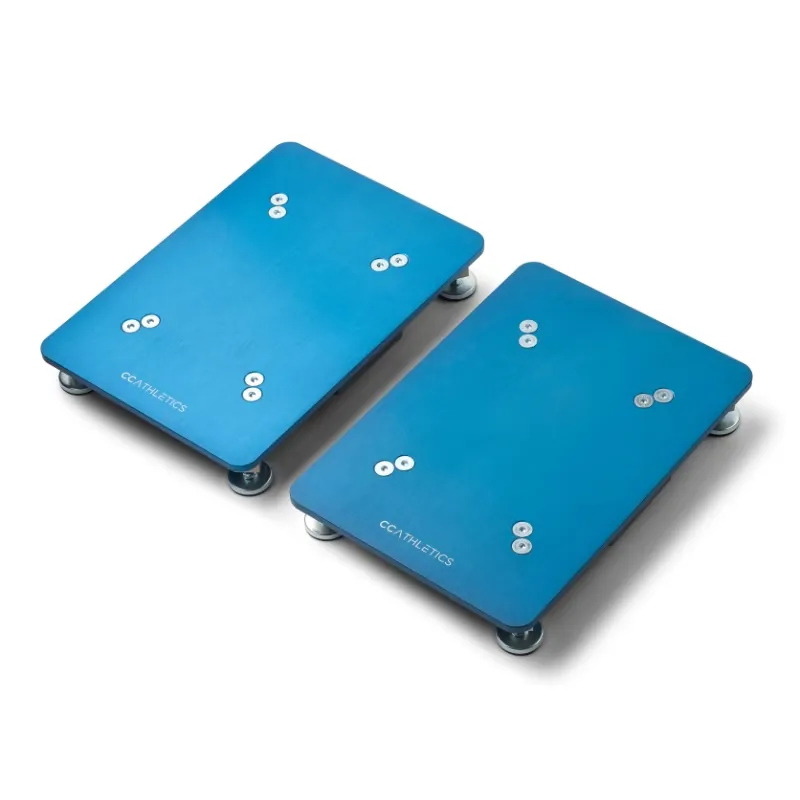
The product behind this article
PlateMate
Dual force plates with 4 000 kg max load and externally validated precision.
Explore PlateMate →