
October 9, 2025
PlateMate vs Vald ForceDecks: A Direct Comparison of Metrics
We stacked PlateMate on top of Vald ForceDecks and ran CMJ, squat jump, drop jump and IMTP trials. r ≥ 0.98 on nearly every metric — see the full data.
We’ve been eager to share more validation data for PlateMate, and today I’m excited to present our internal comparison study against Vald’s ForceDecks system. Vald ForceDecks is an excellent product, and it’s the system we’re most frequently asked to compare PlateMate against.
So, while we’ve been waiting for our university study comparing PlateMate to AMTI force plates to be published (more on that below), we decided it was time to provide some concrete data on how PlateMate performs against one of the most popular force plate systems in the market.
Background: Why This Study?
Our collaboration with the University of Belgrade in Serbia produced excellent results comparing PlateMate to research-grade AMTI force plates, showing very high accuracy in the raw signal measurement. However, publication has been delayed due to political issues affecting Serbian universities, which have severely limited their operations (staff is limited to 1hr of work per day). We understand that third-party, unbiased studies are the gold standard, but we didn’t want to wait indefinitely before sharing more validation data with our community.
So, we conducted an internal test comparing PlateMate directly to Vald ForceDecks. Is it as rigorous as a peer-reviewed study? No. Is it better than nothing? Absolutely. We believe transparency about our testing process and results serves our customers better than waiting in silence. And we hope that you trust us in delivering truthful results.
Test Setup
The testing protocol was straightforward:
- Equipment: Vald ForceDecks (medium size version) placed directly on top of PlateMate
- Connection: Both systems used USB connection for synchronization
- Subjects: Two individuals from our office — myself (Claes) and my colleague Ulrik
- Protocol:
- Jumps: Each person performed 10 repetitions of each jump type
- Countermovement Jumps (CMJ): 20 total (10 per person)
- Squat Jumps (SJ): 15 total (10 from Ulrik, 5 from myself)
- Drop Jumps (DJ): 20 total (10 per person)
- Isometrics: 3 IMTP trials
We chose to report results using Vald’s metric terminology to make comparisons clearer for users familiar with their system. For example, what we typically call “Jump Height (Net Impulse)” is reported here as “Jump Height (Imp-Mom)” to match Vald’s naming convention.
Raw Signal Quality: Virtually Identical
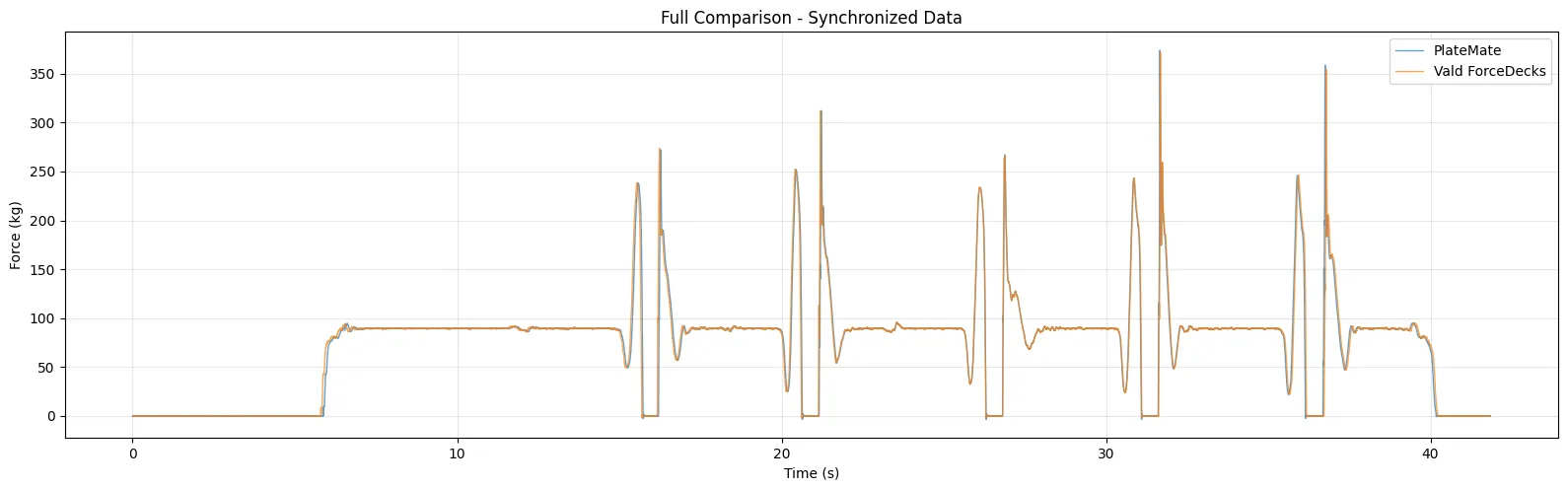
The first and most fundamental comparison is the raw force signal. After all, if the force-time curves don’t match, nothing else matters.
The synchronized data speaks for itself. The PlateMate and ForceDecks signals are essentially overlaid on top of each other throughout the entire jump cycle. This validates what we found in our AMTI comparison: PlateMate captures force data with exceptional fidelity.
Jump Height Validation: Three Different Methods
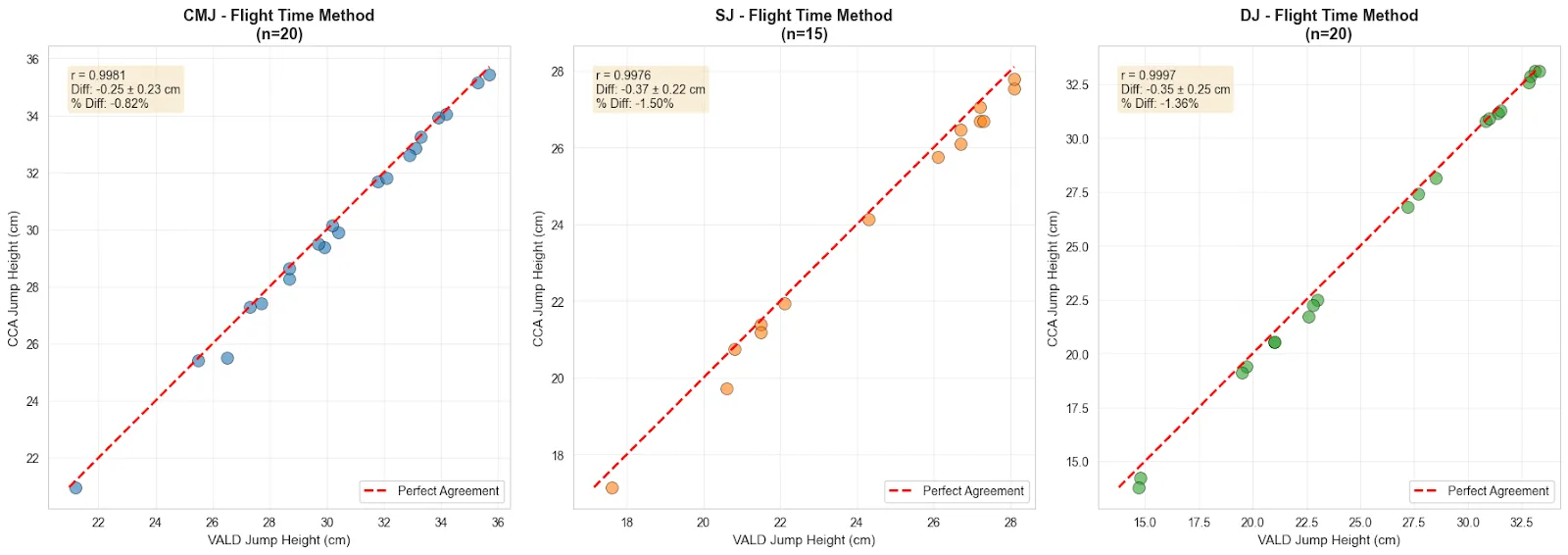
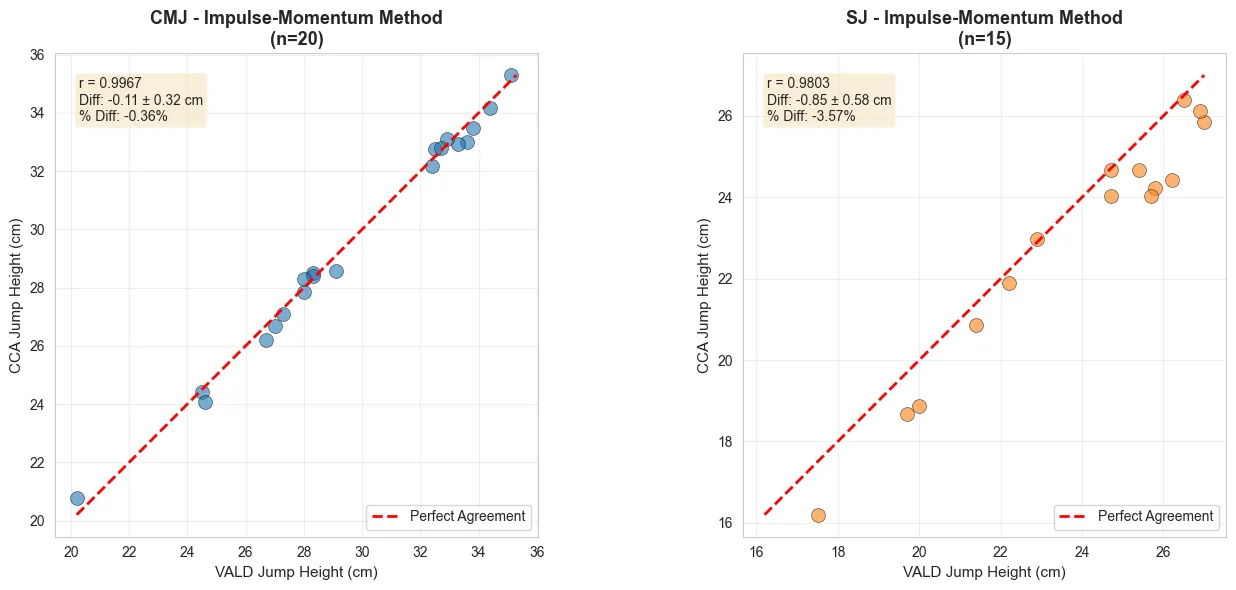
We compared jump height calculations using three different methods across all jump types. The correlation coefficients and percentage differences tell a compelling story:
Countermovement Jump Results (n=20):
- Flight Time Method: r = 0.9981, Diff: −0.25 ± 0.23 cm (−0.82 %)
- Impulse-Momentum Method: r = 0.9967, Diff: −0.11 ± 0.32 cm (−0.36 %)
Squat Jump Results (n=15):
- Flight Time Method: r = 0.9976, Diff: −0.37 ± 0.22 cm (−1.50 %)
- Impulse-Momentum Method: r = 0.9803, Diff: −0.85 ± 0.58 cm (−3.57 %)
Drop Jump Results (n=20):
- Flight Time Method: r = 0.9997, Diff: −0.35 ± 0.25 cm (−1.36 %)
The correlations are exceptional across all methods and jump types, with r-values ranging from 0.98 to 0.9997. The absolute differences are remarkably small — well within the noise margins you’d expect from mechanical/calibration variability and measurement precision limits.
Comprehensive Metric Analysis
We analyzed a selection of the most commonly used metrics in jump testing. We didn’t have time to include them all. We hope to do so later. Here’s what we found:
Countermovement Jump Metrics (n=20)
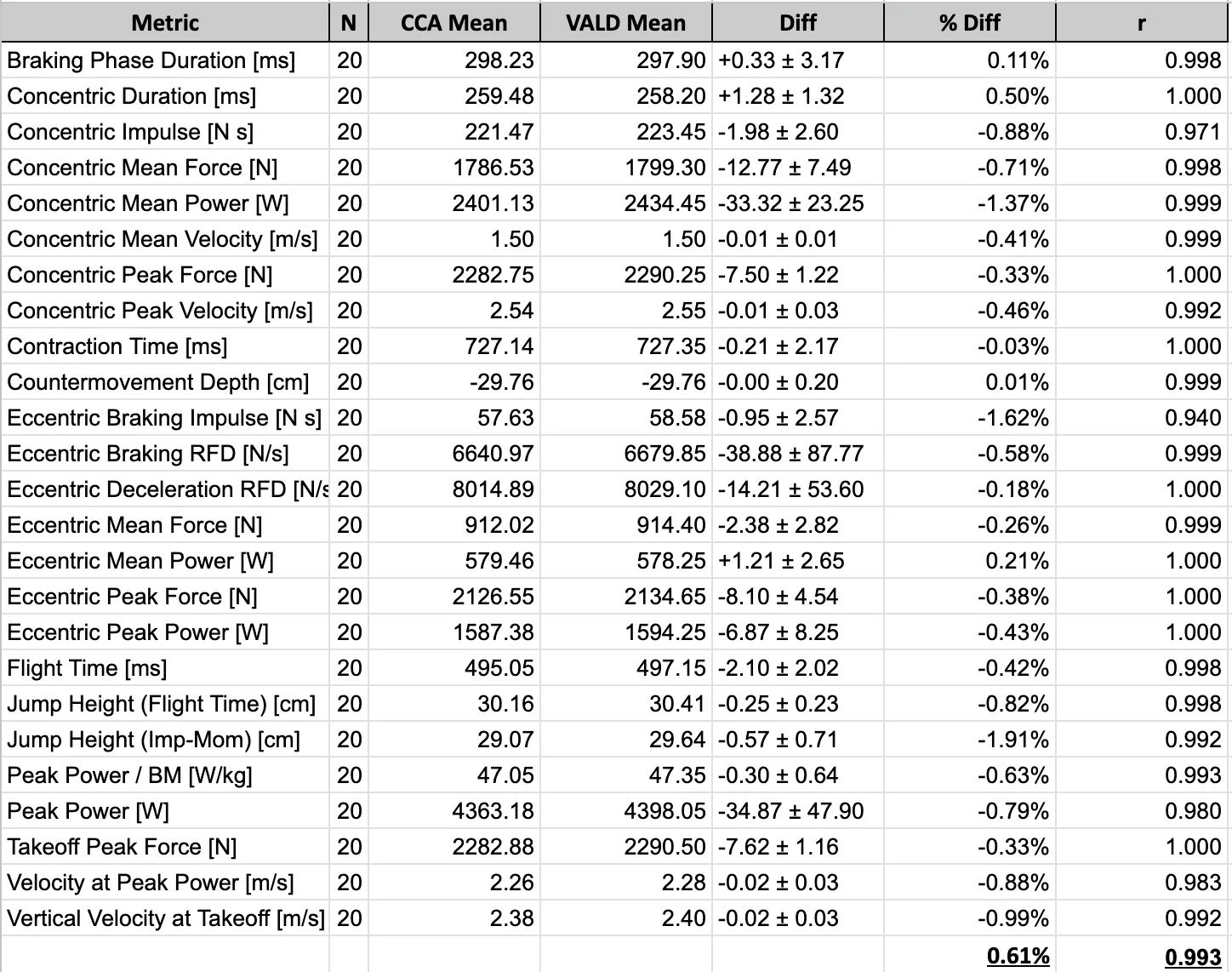
The overall agreement was outstanding, with an average percentage difference of just 0.61 % and an average correlation of r = 0.993. Key findings:
- Concentric Peak Force: Perfect correlation (r = 1.0000), −0.33 % difference
- Takeoff Peak Force: Perfect correlation (r = 1.0000), −0.33 % difference
- Peak Power: r = 0.980, only 0.79 % difference
- Flight Time: r = 0.998, −0.42 % difference
- Concentric Mean Power: r = 0.999, −1.37 % difference
Squat Jump Metrics (n=19)
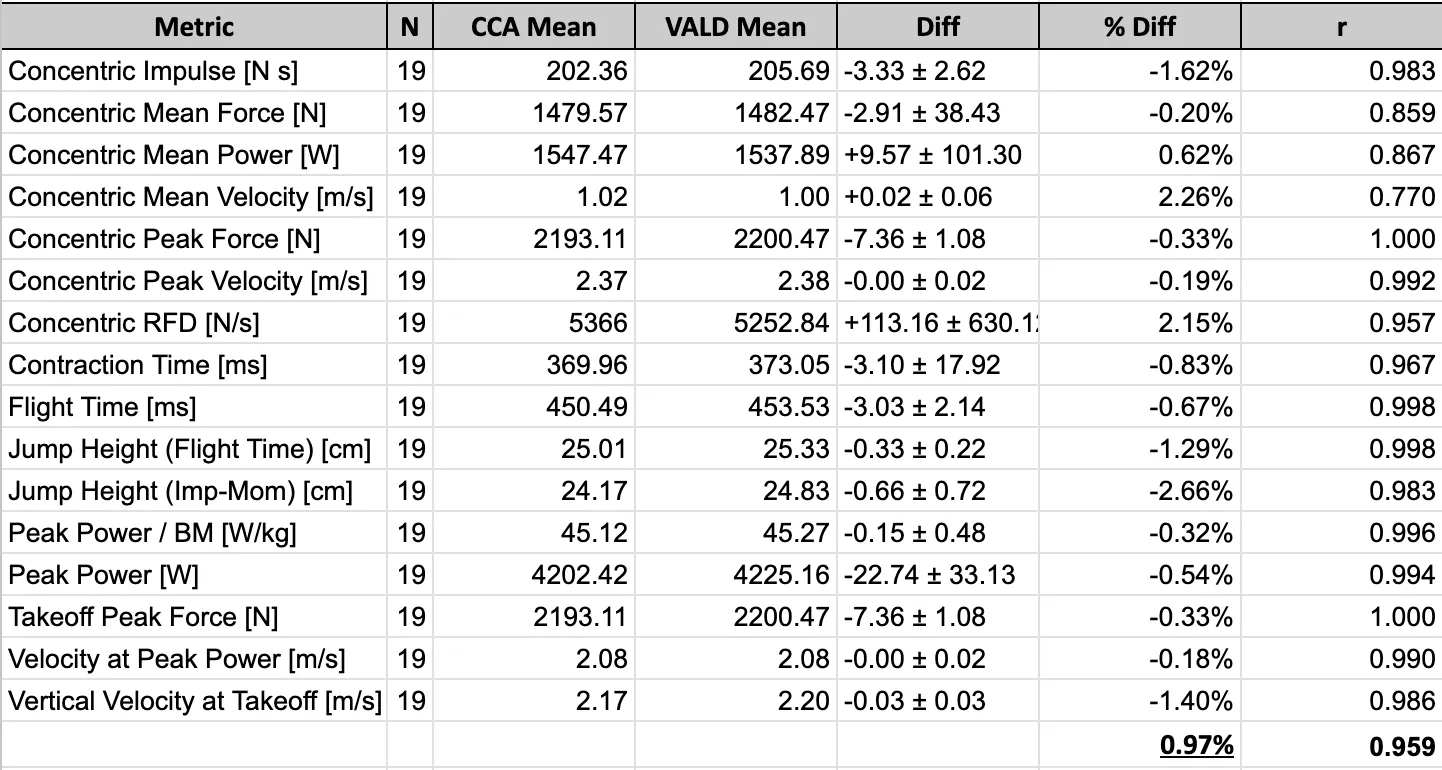
Squat jumps showed similarly strong agreement, with an average percentage difference of 0.97 % and average correlation of r = 0.959. Notable results:
- Concentric Peak Force: Perfect correlation (r = 1.000), −0.33 % difference
- Takeoff Peak Force: Perfect correlation (r = 1.000), −0.33 % difference
- Flight Time: r = 0.998, −0.78 % difference
- Peak Power: r = 0.994, −0.54 % difference
Drop Jump Metrics (n=20)

Drop jumps demonstrated excellent agreement with an average percentage difference of 1.57 % and average correlation of r = 0.998:
- Jump Height (Flight Time): r = 1.000, −1.36 % difference
- Flight Time: r = 1.000, −0.74 % difference
- Peak Landing Force: r = 0.994, 2.32 % difference
An Important Finding: Movement Detection Differences
UPDATE Oct 22nd 2025: These differences have now been corrected for and the results in this article have been updated.
Not everything matched perfectly, and I think it’s important to be transparent about this. We found a systematic difference in some metrics like Jump Height calculated from Impulse-Momentum in Squat Jumps and Countermovement Depth.
In both cases, PlateMate’s values were systematically lower than ForceDecks. After investigating, I traced this to a difference in how the two systems detect the start of movement. This timing detection influences when integration begins for impulse calculations, which directly affects these metrics.
This isn’t a signal quality issue — it’s an algorithmic difference in how we identify movement onset from the force signal. Over the next few weeks, I’ll be examining our detection algorithm to see if we can achieve better alignment with Vald’s approach while maintaining the accuracy we’ve validated against AMTI plates.
What Do These Results Mean?
The differences we’re seeing across most metrics are small enough that they could easily be attributed to:
- Measurement noise: All force plates have some inherent electrical noise
- Mechanical coupling: Despite careful setup, perfect mechanical transfer is impossible
- Sampling synchronization: Slight timing offsets between systems
- Algorithm differences: Minor variations in how each system processes raw data into metrics
The remarkably high correlations (most above r = 0.99) indicate that PlateMate and ForceDecks are measuring the same underlying phenomena with exceptional consistency. The small absolute differences are well within what you’d expect from comparing any two force plate systems.
IMTP (Isometric Mid-Thigh Pull) Validation Results
We’ve also validated our PlateMate force plates against Vald ForceDecks for IMTP (Isometric Mid-Thigh Pull) testing — a critical assessment for maximal strength and rate of force development used by strength & conditioning professionals worldwide.
Test Protocol
- Test Type: Isometric Mid-Thigh Pull (IMTP)
- Trials: 3 maximal effort pulls
- Systems: Simultaneous measurement on both Vald ForceDecks and CCA PlateMate
- Sample Rate: 960 Hz
Results
The table below shows the comparison of 16 key IMTP metrics across 3 trials:
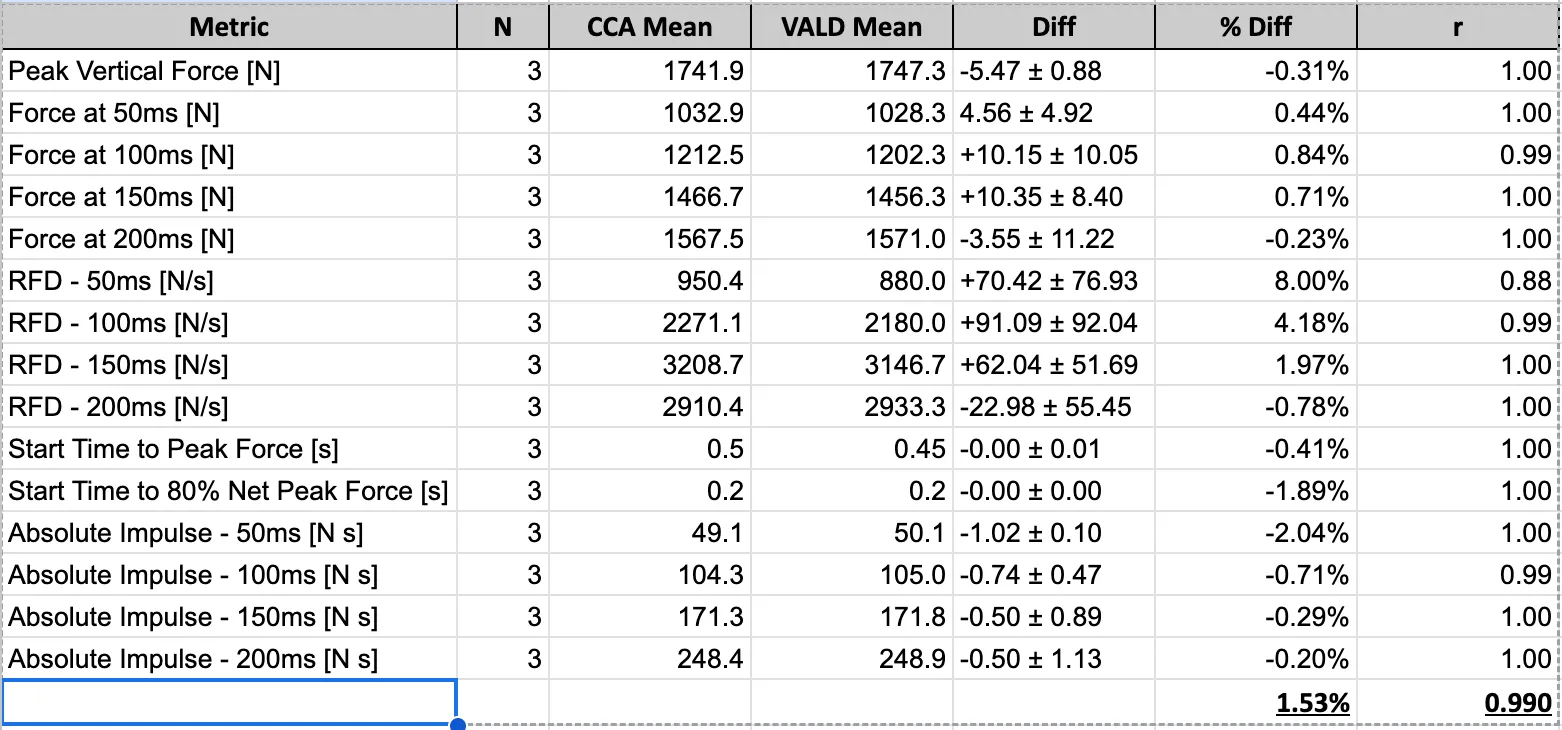
Key Findings
Overall Accuracy: 1.53 % mean difference with r = 0.993 correlation.
The results demonstrate exceptional agreement across all metric categories:
Peak Force Metrics
- Peak Vertical Force: −0.31 % difference
- Force @ 50 ms: +0.44 %
- Force @ 100 ms: +0.84 %
- Force @ 150 ms: +0.71 %
- Force @ 200 ms: −0.23 %
Rate of Force Development (RFD)
- RFD @ 50 ms: +8.00 % difference
- RFD @ 100 ms: +4.18 %
- RFD @ 150 ms: +1.97 %
- RFD @ 200 ms: −0.78 %
Note on RFD @ 50 ms: The larger difference at 50 ms (+8.00 %) is expected and not concerning. In the early phase of force development, absolute force values are still very small (typically 30–60 N above baseline), which means even tiny differences of 5–10 N in force measurement translate to larger percentage differences in calculated RFD. As the time window increases (100 ms, 150 ms, 200 ms), the absolute forces are much larger, so the same measurement precision results in much smaller percentage differences. This is a well-known characteristic of early-phase RFD metrics and why many practitioners focus on 100 ms+ timepoints for more reliable assessments.
Impulse Metrics
- All impulse measurements (50 ms, 100 ms, 150 ms, 200 ms) within 2.04 % of Vald
Timing Metrics
- Time to Peak Force: −0.41 %
- Time to 80 % Net Peak Force: −1.89 %
What This Means
IMTP testing presents a unique challenge because the athlete remains standing on the force plates throughout the entire test (unlike jumps where force returns to zero). Our algorithm successfully handles this by:
- Baseline Detection: Accurately identifies standing body weight (~950 N baseline)
- Trial Separation: Correctly identifies individual pulls when force returns near baseline
The 1.53 % mean difference and 0.993 correlation with Vald ForceDecks validates PlateMate as a clinical-grade tool for IMTP assessment, matching the industry standard across all critical metrics.
What’s Next?
This study covered a focused selection of commonly used metrics, but both PlateMate and ForceDecks calculate many more. In the future, we plan to:
- Conduct a deeper analysis examining additional metrics
- Expand testing to include more subjects and testing variations (like Center-of-Pressure)
- Continue pursuing peer-reviewed publication of our AMTI validation study
We’re also committed to ongoing validation as we develop new features and metrics. Transparency in our measurement accuracy is fundamental to what we do at CC Athletics.
Conclusion
While this internal study doesn’t replace peer-reviewed research, it shows that PlateMate delivers measurements that align exceptionally well with Vald ForceDecks across the metrics that practitioners use most. The raw signal quality is virtually identical, and the derived metrics show great agreement.
For practitioners considering PlateMate, these results should provide confidence that you’re getting accurate, reliable data that’s directly comparable to one of the industry’s established systems.
If you have questions about this study or want to discuss specific metrics, please don’t hesitate to reach out. We are always happy to get feedback on our products.
Claes C. Jakobsen Founder, CC Athletics · Biomedical Engineer