
Internal test (CC Athletics office)
This blog post compares raw force-plate signals from CC Athletics PlateMate (960 Hz) and Vald ForceDecks (1000 Hz) on a single recording: one subject performing 5 countermovement jumps (CMJs).
Setup: the Vald plate was placed on top of PlateMate (stacked), so the two devices share a mechanical load path and observe the same physical event simultaneously. See the Setup section below for the full implications.
The question we're trying to answer: for the raw signal (not derived metrics like jump height or peak power), how closely do these two devices agree?
TL;DR — what we found:
- Static body weight agreement: ~0.08 % (~70 g out of ~89.5 kg).
- Peak force agreement during jumps: ~0.45 % (~1.7 kg out of ~374 kg).
- Time-domain RMSE: ~0.85 kg raw / ~0.36 kg at 5 Hz low-pass (~1.2 % / ~0.5 % of mean force).
- Bland-Altman 95 % limits: ~±1.6 kg.
- Power-weighted coherence over 0–30 Hz: ~1.00. Coherence is ≥ 0.99 in every sub-band (0–2, 2–5, 5–10, 10–30 Hz).
Within this single stacked-plate recording, PlateMate and Vald ForceDecks are practically indistinguishable in their measurement of the shared mechanical signal. They agree to sub-percent on every bulk metric and to sub-kilogram on point-to-point RMSE.
Important caveats: n = 1 subject, n = 1 recording. Only summed total vertical force was compared (no bilateral / centre-of-pressure / derived-metric comparison). None of the numbers below should be read as population-level claims about device equivalence — they describe this recording with this stacked configuration.
This is the publication-friendly version. The extended analysis contains the full audit trail (alignment defence, jump-only coherence iterations, amplitude-ratio / phase diagnostics) for readers who want to see the working.
Setup: Stacked plate configuration
Important to know before reading the analysis below: this is not a side-by-side comparison. The Vald ForceDecks plate was placed on top of the PlateMate, and both devices recorded the same subject simultaneously. The mechanical load path is:
Subject → Vald top surface → Vald load cells → Vald base → PlateMate top surface → PlateMate load cells → floor
PlateMate was tared with the Vald plate on it, so both devices report ~0 unloaded and ~subject body weight when standing.
Why this setup matters:
- Strength: the two devices are guaranteed to see the same physical event — they share one mechanical load path. This is the most rigorous configuration for force-plate validation and removes the "are they both observing the same thing?" question entirely.
- Caveat in principle: the Vald plate sits between the subject and PlateMate as a mechanical element with mass and stiffness. During fast vertical accelerations (landing impacts in particular), inertial forces from the Vald plate's mass would in principle appear as a small additional load on PlateMate that Vald itself doesn't see. In practice on this CMJ recording, no such effect is detectable: point-to-point coherence is ≥ 0.99 in every sub-band 0–30 Hz.
- Implication: for this CMJ recording, treat the differences below as residual measurement noise between two devices observing the same mechanical signal.
Data and alignment
PlateMate sampled at 960 Hz, Vald at 1000 Hz. Both devices' raw force readings were summed across their load cells and converted to kg, then resampled onto a common 1000 Hz timeline and time-aligned to each other so each sample compares the two devices at the same point in time.
Aligned recording: 41989 samples at 1000 Hz, 42.0 s of overlapVisual comparison
A first look at the two synchronised signals — full overview and zoomed in on the highest peak.

Bulk-metric agreement
How closely do the headline numbers — peak force, mean force, body weight — agree between the two devices?
============================================================
COMPARISON STATISTICS
============================================================

Absolute Difference (PlateMate - Vald):
  Mean: -0.00 kg
  Std Dev: 0.81 kg
  Median: 0.02 kg
  Min: -18.54 kg
  Max: 15.64 kg

Percentage Difference (for forces > 10.0 kg):
  Mean: -0.02%
  Std Dev: 1.42%
  Median: -0.03%
  Samples included: 31755 / 41989 (75.6%)

Pearson Correlation: 0.999879
RMSE: 0.81 kg
RMSE (% of mean force): 1.12%

Peak Force:
  PlateMate: 373.64 kg
  Vald: 371.95 kg
  Difference: 1.69 kg (+0.45%)
Findings — bulk-metric agreement:
| Measure | Value |
|---|---|
| Pearson correlation (point-to-point) | ~0.9999 |
| Peak force agreement | ~+0.45 % (~373.6 vs ~371.9 kg) |
| Mean force agreement | ~0 % (essentially identical) |
| Time-domain RMSE | ~0.81 kg (~1.1 % of mean force) |
| Bland-Altman bias | ~0 kg |
| Bland-Altman 95 % limits | ~±1.6 kg |
PlateMate and Vald agree to sub-percent on the bulk measures and to sub-kilogram on the point-to-point comparison. The two are essentially observing the same signal at the same time at the same scale.
A caveat worth keeping in mind reading on: this is a single recording from a single subject doing 5 CMJs. None of the numbers in this blog post should be read as population-level claims.
Frequency-domain comparison
With the time-domain disagreement small (~0.85 kg RMSE), the question is now: do the two devices agree at every frequency band that carries jump signal, or only at the dominant low-frequency one?
Two views:
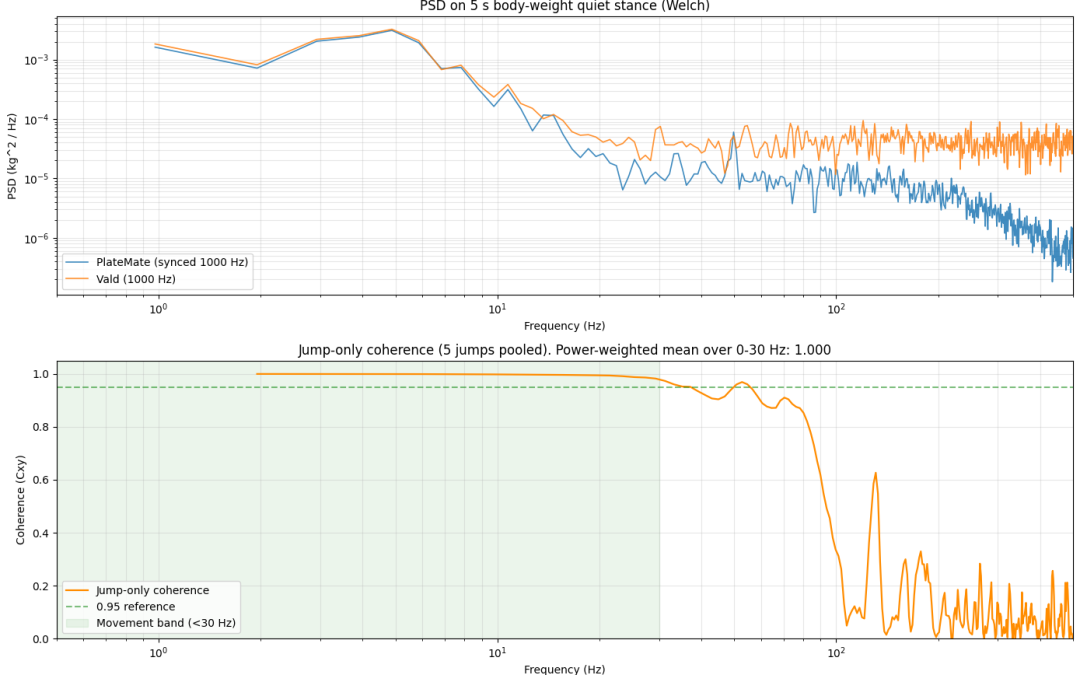
- Power Spectral Density (PSD) on a 5-second body-weight quiet stance shows each device's noise floor under load.
- Magnitude-squared coherence, broken into frequency bands and weighted by signal energy, shows where the two signals are linearly correlated. Coherence is computed on jump-only windows (±1 s around each of the 5 detected jump peaks, pooled across jumps via summed Welch cross-spectra) so quiet-stance segments — where each device sees only its own uncorrelated noise — don't dilute the answer. ====================================================================== Body-weight quiet-stance noise floor PlateMate: SD=0.406 kg, mean=89.51 kg
Vald: SD=0.426 kg, mean=89.58 kg ====================================================================== Jump-only coherence by frequency band Overall 0-30 Hz power-weighted coherence: 0.9997 Band Energy % Coherence (pwr-wtd) 0-2 Hz 64.45% 0.9999
2-5 Hz 20.50% 0.9998
5-10 Hz 11.73% 0.9991
10-30 Hz 3.32% 0.9960

Findings — Frequency domain:
Body-weight under-load noise floor: PlateMate's time-domain SD during quiet stance is essentially identical to Vald's (~0.41 vs ~0.43 kg, ~5 % difference). On integrated quiet-stance PSD (Welch-detrended), PlateMate runs ~30 % lower; on median PSD above 100 Hz, PlateMate is roughly an order of magnitude lower. Both gaps live above the movement band and are well below biomechanically meaningful magnitudes — human jump force has effectively no content above ~30 Hz.
Body-weight match: ~89.5 (PM) vs ~89.6 kg (Vald) — a ~70 g difference (~0.08 %). Note: this number reflects both raw-signal sensing AND how each device is calibrated (PlateMate is calibrated in-house at CC Athletics; Vald uses its own procedure). The agreement tells us the two calibration procedures produce mutually consistent results.
Coherence is near 1.0 in every band of the movement signal. Power-weighted across 0–30 Hz, coherence is ~1.00; broken down by band, it stays ≥ 0.99 in every sub-band 0–2 Hz, 2–5 Hz, 5–10 Hz, and 10–30 Hz. The two devices agree on the same signal at every frequency that matters for jump biomechanics.
Validating with filtered RMSE
A consistency check on the frequency-domain story above: low-pass filter both signals at progressively lower cutoffs and recompute time-domain RMSE. If most of the residual lives above 5 Hz, the numbers should drop sharply between 30 Hz and 5 Hz cutoffs.
==============================================================================
FILTERED RMSE VALIDATION
==============================================================================

Cutoff                     RMSE (kg)      RMSE (% of mean)              vs raw
------------------------------------------------------------------------------
Raw (no filter)                0.849                 1.17%
Low-pass 30 Hz                 0.594                 0.82%     30.1% reduction
Low-pass 10 Hz                 0.457                 0.63%     46.2% reduction
Low-pass 5 Hz                  0.359                 0.49%     57.7% reduction
Findings — Filtered RMSE:
| Cutoff | RMSE (kg) | RMSE (% of mean) |
|---|---|---|
| Raw | ~0.85 | ~1.2 % |
| Low-pass 30 Hz | ~0.59 | ~0.8 % |
| Low-pass 10 Hz | ~0.46 | ~0.6 % |
| Low-pass 5 Hz | ~0.36 | ~0.5 % |
Most of the (already small) residual lives above 5 Hz: low-pass filtering at 5 Hz drops RMSE by ~58 % from ~0.85 kg to ~0.36 kg. The remaining ~0.36 kg is comparable to the quiet-stance noise SD (~0.42 kg) — i.e. at the 5 Hz cutoff, the two devices disagree on the jump signal at the same level they each disagree with their own baseline noise. That's as close to bit-for-bit identical, modulo sample-level discretisation and ordinary measurement noise as two independent devices can be.
What this means in practice (plain-language summary)
This section translates the analysis above into practical terms, for readers who use force plates day-to-day rather than analyse raw signals.
What we tested
One person performed 5 countermovement jumps on a PlateMate force plate with the Vald ForceDecks plate placed on top. Both devices recorded the same physical event simultaneously. We compared their raw measurements — the force readings every millisecond — to see how closely they agree.
What we found, in plain language
Sub-percent agreement on the things that matter for assessment:
- Body weight: the two devices agree to within ~70 grams (out of ~90 kg). About the weight of two AAA batteries.
- Peak force during a jump: within ~0.5 % (about 1.7 kg out of 374 kg).
- Mean force across the whole recording: essentially identical.
- Pointwise force-time agreement: ~0.85 kg RMSE on the raw signal (~1 % of mean force), dropping to ~0.36 kg with mild low-pass filtering — about the same magnitude as quiet-stance measurement noise.
A note on the calibration numbers: the body-weight, peak-force, and mean-force agreement is partly a reflection of how each device is calibrated. Both PlateMate and Vald are individually calibrated against known reference weights — PlateMate's calibration is performed in-house at CC Athletics, Vald uses its own procedure. So these numbers tell you that the two calibration procedures produce results consistent with each other to a fraction of a percent. From a clinician's standpoint, that's exactly what you want: the same physical event reads the same kilograms on both devices.
What this means for your practice
For CMJ-based assessments: the standard headline numbers a clinician would read off a force-time trace are built from signal characteristics — peaks, time-integrals, threshold crossings, slopes — that this comparison shows agreeing to sub-percent. The choice between PlateMate and Vald ForceDecks is unlikely to change your clinical judgement.
For tracking an athlete over time: stick with the same device throughout. Either device is consistent enough on its own; mixing measurements between devices can introduce small differences (sub-percent) that don't reflect real change in the athlete.
What this analysis does not tell you
- We didn't test drop jumps or other hard-impact movements in this blog post.
- We didn't compare left-vs-right foot symmetry. Only the total combined force across both feet was compared.
- One recording, one subject. The agreement we found is consistent with what published force-plate validation studies typically report, but a larger sample would strengthen the conclusion.
- We didn't test absolute calibration accuracy against a traceable reference mass — only that the two devices agree with each other. If both have a small calibration drift in the same direction, this comparison can't reveal it.
Bottom line
For CMJ-based assessment, this comparison supports treating PlateMate as practically equivalent to Vald ForceDecks. The bulk metrics — body weight, peak force, mean force — agree to a fraction of a percent, and the raw point-to-point signals agree to about half a percent after mild low-pass filtering.